Wednesday, 25 May 2011

Nature Conservancy's adaptation project in Choiseul, Solomon Islands

Rosalie Nongebatu - Solomon Islands Broadcasting Corporation

Apia, Samoa - Traditional institutions are vital in the governance of natural cultural resources when it comes to implementing community-based responses to Climate Change Adaptation and Disaster Risk Management, particularly in the pacific, where most of the land or islands are under customary land ownership.

Robin James, The Nature Conservancy

Robin James of The Nature Conservancy Organization was speaking this morning at the Lessons for Future Action Conference on the organization’s experiences on a particular project being run in Choiseul Province in the North-Western region of the Solomon Islands.

Ms James says Chiefs and traditional leaders from across the island gathered in the provincial capital, taro, in 2008 for the Lauru Land Conference and Tribal Community where they declared a system of protected areas, both marine and terrestrial areas over the whole island of Choiseul.

She says the arrangement has been developed since over the years with participation from the community level.

“In February this year the TNC undertook a number of participatory activities in a small community in the province known as Mboemboe, to understand what this would look like and further visualise what the protected networks are and also in the context of climate change for the whole island”.

The number of participatory tools implemented with partners consisted of household surveys, participatory videos where members of the communities were given videos to film their own experiences in climate change and also development of conservation issues in the community.

“Household surveys were done to understand the economics of climate change, the costs, the current status and what those future costs would be, making it a major economic component of the project .”

The project also had a participatory 3 dimensional modeling focus which combines local spatial knowledge, mind maps of familiar settings, at the same time combining the scientific component of GIS.

The participatory 3D modeling (P3DM) involved more half of the community, including women and children and combined community mapping with open discussions on land-use and land-use planning scenarios.

During a ten day P3DM exercise, participants helped construct a physical, hands-on scale model made of wood-and paper model of their community, led by an expert in P3DM from the University of Wollongong and the University of Queensland with Melanesians.

Many people were involved in these activities from community members, government, local and regional TNC staff, scientists, local NGOs as well as partners from other parts of Melanesia.

She said It is anticipated that by 2012 every community in Choiseul should have a plan that includes adaptation and should have begun an initial set of activities.

According to Ms James’ presentation, lessons learned from these activities will be spread by participants and through visual outputs such as video to inform future work in Melanesia and Micronesia and elsewhere in the Pacific.

Pacific Conference of Churches pilot climate change project

Moana Ainu'u - Niue Broadcasting Corporation

Apia, Samoa - The Pacific Conference of Churches (PCC) piloted a disaster risk reduction approach called Climate Intervene and Disaster Risk to assist its church communities to become proactive in addressing the changes in their physical environment.

This project introduced in five countries in the Pacific – Fiji, Kiribati, Solomon Islands, Tuvalu and Vanuatu is aimed at empowering Pacific People to rethink their strategies, and adopt realistic adaptation and risk reduction methods.

Reverend Ikani Taliai Tolu

“Through its methodology, the PCC employs the notion that climate impact and risk assessment is the first step at identification of areas threatened by disasters especially the vulnerable to climate change,” said Reverend Ikani Taliai Tolu, during a presentation at the Lessons Learnt for Future Action conference in Samoa.
 
His belief is that a hazard only becomes a disaster when the community is not able to cope with it.

“The findings from the five pilot countries demonstrated to us that although communities adaptation strategies may be varied and depend on local context, social networks play a pivotal role in accessing appropriate climate knowledge and resources”.

A tailor made plan for communities or individual needs must find its place and the justification will become apparent when risk reduction measures are recognised.

The Pacific Conference of Churches has one hundred different religious denomination members from 18 countries, one of the biggest religious establishments of the region. It views climate change as an injustice that continues to affect the most vulnerable.

“As we may all appreciate climate change is an issue of justice, because those who have least contributed to this global problem, and have the least capacity to adapt, stand to lose the most, and in certain cases lose entire island communities from rising sea levels that have been aggravated further by frequent and stronger storm surface”.

Faced with unprovoked injustices, people of the pacific must adjust and continue the road of adaptation, he said.


Your thoughts...

Michiline Time - Senior Journalism Student, National University of Samoa

What are your views on the thought that there is too much focus on climate change policies by governments and not enough climate change action on the ground?
“I would certainly agree, I think that it’s very difficult to transpose government policies into actions on the ground particularly in the Pacific where there are many Islands, particularly a lot of outer Islands, very isolated.   I think the way forward for increasing more actions on the ground is to provide support to provincial governments, NGOs and people that are working directly with communities, that’s definitely an important area to move forward into.”
Olivia Warrick


“In a lot of countries it’s true that there’s a lot of work and climate financing going into policy development and very little funds are flowing down to the communities, to actually address concrete adaptation issues that would build community resilience to climate and sea level change. A lot of times money is spent on developing policies and strategies and  unfortunately nothing is done on the ground but again it depends a lot on how pacific island countries set up their climate change national institutional arrangements.  If you have a strong national climate change institutional arrangement, that has oversight on all climate change activities at the national level then you are able to have a mechanism where decisions can be made at a higher level to ensure that a bigger potion of financing is actually translated into adaptation projects on the ground, that builds community capacity to adapt to climate and sea level change.  Also that sort of institutional arrangement will ensure that vulnerability assessments or vulnerability work that has already been done is not duplicated or repeated but is used as basis to mobilise funds and translate these assessments that have been sitting  in a lot of  government offices into actual project on the ground to help build communities resilience.”
Brian Phillips - Vanuatu


"You need to raise the communities as they are the ones who are feeling the brunt of climate change impacts and for them to take action they need to know actively what is the science, how does the impact will take place and what actions are needed.  These actions can be explained to them through some simple information sheets like that one that USP has recently published and released, a series of fact sheets on some information that will be useful to take it to the communities so they are aware of what  the issues are, what  the concerns are and how they can do it.   This is taking time but ultimately it will succeed, the communities have to be made aware of this and raise their capacity so they can cope with the oncoming threats of climate change."
Professor Murari Lal, University of the South Pacific


The communities are right in sense that they say that there are a lot of government policies.  I think personally it’s not a question of policy per say.  The policies that the government have ensure that there is disaster risk reduction at the community level as well as ensuring that the climate change cause is built up, so it’s more of a question of interpretation.   It’s not that the government does not want to do anything.  I feel personally it’s just that they lack the capacity of how to go about implementing projects.   There is a lot of international funding that has come up over the years related to climate change adaptation but one thing that keeps coming up again and again when I talk to different government agencies in different countries is that they really don’t have the capacity, so it’s not that the government doesn’t want to implement or a question of policy, for me it’s a question of capacity development of the government.”
Puja Sawhney


“I agree!  But from my own knowledge and experience, climate change is something that is building up, so therefore, who knows that the policies of climate change would surpass other policies.“
Akisi Korodrau


Empowering communities in Tonga

By Mona Ainu'u - Niue Broadcasting Corporation

Apia, Samoa - The lessons learnt from community empowerment projects in Tonga to address climate change and disaster preparedness were shared during the “Lessons learnt for future action” conference in Samoa this week.

The Tonga Community Development Trust is an indigenous, non-governmental development organisation in Tonga established 30 years ago. The Trust has several community projects in place that focus on climate change and disaster preparedness.

One is the “Community Empowerment and Climate Change Adaptation” to empower coastal communities in Lifuka and Foa Islands in Ha’apai so they can better adapt to the negative impacts of climate change.

The other is the “Coping communities and disaster preparedness” to increase resilience of communities in encountering future natural disasters through the adoption of traditional coping mechanisms in Neiafu, Vava’u and Hihifo of the Ha’apai Islands.


Sione Fakao’si the Executive Director,  Tonga Community Development Trust

“Tonga Community Development Trust was set up with an outlook of helping disadvantaged families and communities in Tonga. That they are living in a safe, secure and healthy environment and are empowered to be self-reliant through sustainable development and preservation of traditional culture and values,” explained Sione Fakao’si the Executive Director.

Through this experience, Mr. Fakao’si shared the message that resilient planning needs as much attention as that of finance.

While these two initiatives are successful in having carried out different activities to raise awareness and actually implement ‘on the ground’ actions, there are still some challenges.

“With steps to adjust there is still a struggle with lack of appropriate materials, unforeseen circumstances of weather challenges, and the continuity of the dependency mentality despite empowerment,” said Fakao’si.

“An understanding must be reached by all parties in order to have an effect on the responsibilities of communities and this will impact on policies and plans.”

One of the key achievements of the projects is the formation of a local Coordinating project team consisting of both government and community leaders to make collective decisions.

For more information on the Tonga Community Development Trust and the two projects please visit:  http://www.tcdt.to/index.html

CARIBBEAN-ENVIRONMENT-Regional governments praised for changed attitude towards climate change

by Ernie Seon - Caribbean Media Corporation

Apia, Samoa – The head of the Belize-based Caribbean Community Climate Change Center (CCCCC), Dr. Kenrick Leslie, says the decision of Caribbean Community (CARICOM) countries to give priority to climate change issues is allowing the region to implement policies relating to the environment.

 However, he told the Caribbean Media Corporation (CMC) that while strides were being made at the policy development, there was urgent need for more to be done at the community level where the issues remained largely unknown and misunderstood.

“We need to continue to approach our work on two fronts, at the community level and at the policy level. We have made more progress at the policy level and the thrust must now be directed at the communities, ensuring that the schools become involved in understanding their role in addressing the effects of climate change,” Dr. Leslie said.

The CCCCC executive director was among delegates who addressed the opening of a four-day conference entitled “Lessons for Future Action: Climate Change Adaptation and Disaster Risk Reduction in Small Island States.”

The aim of the conference is to share experiences and lessons learned in relation to climate change adaptation and disaster risk reduction among Small Island Developing States (SIDS) from the Caribbean, Pacific and Indian Ocean, drawing on experiences from Australia and other countries.

The conference is co-hosted by Australia and the South Pacific Regional Environment Program and is funded by the Australian government, through the Department of Climate Change and Energy Efficiency and the Australian Agency for International Development.

Dr. Leslie, whose Belize based organisation has chosen Caribbean facilitators for the Pacific exchange, said that from 2007 CARICOM government  have accepted that climate change should not be seen solely as an environment issue, but one that involves foreign policies and foreign trade as has been the case with the United States and China.

“If we keep talking about climate change solely as an environmental matter we will never get the kind of support we are looking for, so while the governments have taken the issue to a new level, there is still a whole lot more to be done,” he added.

Dr. Leslie said that over the past three years, the Caribbean has been able to make greater strides than their counterparts in the Pacific and Indian Ocean in setting up strategies for improving the environment and addressing climate change issues. 

However he conceded that very little strides had been made in enforcing policies.

“We could set up the best policies but if we don’t have enforcement it can all go to naught. So our priority at this time would be to ensure that new policies are properly implemented and enforced and then strengthen those that we have already put in place.

“This calls for stronger political will and more involvement of the people especially the youths who will be the benefactors of the future.

“It is through these young people and their community leaders that political leaders could be pressured into making the right decisions,” he told CMC. 

Dr. Leslie lamented the fact that the region has taken a long time to taget young people with regards to climate change issues.

He said he hoped the conference here would result in greater collaboration between the Caribbean and Pacific States and that Australia would extend its climate change funding programme to the Caribbean.

CARIBBEAN-ENVIRONMENT-Official wants closer collaboration between Pacific and Caribbean

by Ernie Seon - Caribbean Media Corporation

Apia, SAMOA – A four-day conference on Climate Change Adaptation and Disaster Risk Reduction in Small Island Development States (SIDS) opened here late on Monday with a call for stakeholders in the Caribbean, Pacific and Indian Ocean to work together in support of national priorities since there was “no room for competition and duplication”.

 “The Lessons for Future Action Conference” will allow delegates to share experiences and lessons learnt in relation to climate change adaptation and disaster risk reduction among SIDS drawing on experiences from Australia and other countries.

Addressing the opening ceremony, Director of the Secretariat of the South Pacific Regional Environmental Programme (SPREP) David Sheppard called for collaboration between the Caribbean and Pacific regions and announced plans for the signing of a Memorandum of Understanding (MOU) this week with the Caribbean Community Climate Change Center (CCCCC).

“This we think represents a major step towards better information sharing and practical cooperation between the Pacific and the Caribbean,” he said, noting that Pacific leaders have identified climate change as the biggest challenge facing their region.

Sheppard said that the magnitude of the challenge “we face and the need for urgent action is also underlined in a major report released Monday by the Australian Climate Commission”.

He said that the tragic earthquake and tsunami in Japan following so closely after the earthquake in New Zealand “remind us again of the power of nature and the vulnerability of Pacific nations to climate change and to natural disasters.

“Small island developing countries both here and in the Caribbean are the most vulnerable on earth to the impacts of climate change,” he told the ceremony.

“We therefore urge all donors to accelerate efforts to support small island developing countries and to meet commitments under the Copenhagen Accord and the associated Fast Start mechanism,” he added.

The conference is co-hosted by Australia and the South Pacific Regional Environment Programme and is funded by the Australian government, through the Department of Climate Change and Energy Efficiency and the Australian Agency for International Development.

The Caribbean’s delegation includes experts from the University of the West Indies (UWI), the Belize-based Caribbean Community Climate Change Centre (CCCCC) and the Belize Red Cross.

The meeting will discuss a wide range of topics including information and awareness raising; national planning and policy frameworks; community-based response to climate change and disaster risk reduction and strategies and on-ground options.

Sharing lessons learnt for future action

By Rosalie Nongebatu - Solomon Islands Broadcasting Corporation


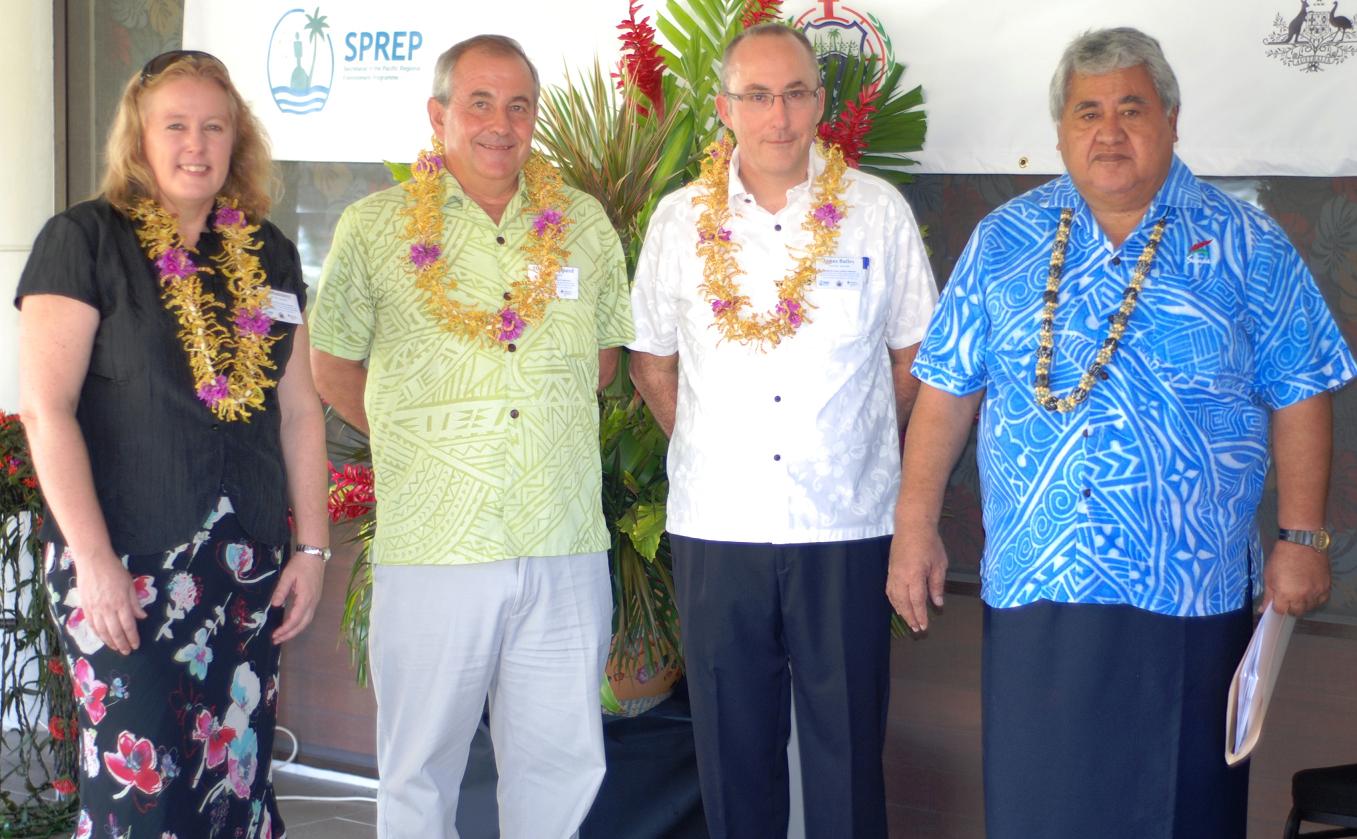
L - R Jo Mummery, David Sheppard, James Bartley, Tuilaepa Lupesoliai Sailele Malielegaoi,
Prime Minister of Samoa
Apia, Samoa - “Adaptation to climate change including how that will change our exposure and risks from natural disasters is a very complex issue.”

Those words by Jo Mummery of the Australian Government’ s Department of Climate Change and Energy Efficiency was to help provide an overview of the Lessons for Future Action Conference now underway in Apia, Samoa.

Ms Mummery says there is uncertainty in how much the climate will change and in some areas it is not known what it means for the different stresses and how that will then impact on societies, industries and environments.

“There is a lot we yet don’t know about how much adaptation is needed and when it is needed, and importantly we don’t necessarily know yet whether actions we take now will continue to be effective in the future, as climate changes more”.

Because of this complexity, participants at the conference need to share their experiences and to reflect on what has been done to date and whether it has worked.  There is also the need to draw upon all the relevant expertise to face future climate change challenges.

 “All knowledge and capacity that will help manage the magnitude of this challenge, knowledge from what has been done, not designed for future climates, and understanding and consideration about what’s been done somewhere else maybe relevant to a specific region or country”.

It is also hoped that experiences will be shared between regions, donors and small island developing states around the world to help understand the challenges faced by SIDS and a way forward.

The conference began on Monday and has participants from throughout the different Small Islands Developing States (SIDS).  Two key issues are the theme for each day -  discussions on these issues are prompted by a panel of presentations made by people from different areas.  A break out group is formed after the presentations for people to look at solutions and think of ways we can best move forward.

The conference is funded by the Australian Government and coordinated by the Secretariat of the Pacific Regional Environment Programme, SPREP.

Lessons for Future Action: Bulletin 1


BULLETIN: MONDAY 23 MAY

DOWNLOAD LINK:  www.sprep.org/documents/dl/230511-MON.pdf   (PDF, 1,011.97 KB)


Tuesday, 24 May 2011

Climate change policy planning in the Pacific

Mona Ainu'u - Broadcasting Corporation of Niue


23 May 2011, Apia, Samoa - National planning and policy frameworks will not work unless, linkages are established and effective approaches taken, according to panellists of climate change strategic planners and policy makers at the "Lessons Learned for Future Action" conference.


For the Small Island Developing States (SIDS) it can be a challenge to gain momentum following policies and national planning.  The need to produce policies is neccessary, but they must also be effectively implemented, national planning is important to construct a robust document for all sectors to follow and sustain.

Albert Williams, Vanuatu

“There is a need for government support as well as donor funding for activities on climate change”, said Albert Williams of Vanuatu.

Plans and policies need funding to implement, there has been an urgent call from all Small Islands Developing States for donor agencies to fast track and accelerate funding.  Without the funds, implementation of national plans and policy frameworks is difficult.

Then there is also the issue of 'over-consultation' and too many policies, as pointed out by Sione Fulivai, the Second National Communication Project Officer from Tonga.

“For some communities at grassroots level, there are too many policies for consultation and not enough action taken to progress ahead and mobilising people can be a challenge."

One clear message from this afternoons meeting, is that there is a need to collaboratively engage all parties if there is to be an effective future policy to address real Climate Change issues in Small Island States.

It is a huge task to confront to make sure each policy remains neutral and that all parties are considered.  There is a fundamental obligation to clearly strategise and clarify plans so they are effective and without prejudice.


For the Carribean countries, Dr. Kenrick Lesliehead of the Belize-based Caribbean Community Climate Change Center (5Cs), emphasised their regional need to establish an institution to address the real problem of climate change with positive results.


“The heads of Carribean countries in 2007 asked the centre to put together a framework that would address the issues of climate change and help us in our development that will be resilient to the impacts.  The heads approved this in 2009 and we are now in the process of putting together the implementation plan of that framework.  So you can see that has regional but has in its component at the national level”.


The approach by the Carribean countries to combine efforts in strengthening its resilient policies, was applauded by other SIDS with an encouraging message to review their own approach.


Sharing climate science in the media

By Rosalie Nongebatu - Solomon Islands Broadcasting Corporation

23 May Apia, Samoa - Delegates at the Lessons for Future Action Conference have been reminded of the importance of communicating the Science of Climate in a manner that is culturally considerate and locally relevant.

This was one of the challenges in Communicating Climate Science put forward by the Pacific Climate Change Editor Cherelle Jackson during her presentation under the Information and Awareness Raising Session this morning.

Another challenge Ms Jackson pointed out included the lack of knowledge and background in Science by pacific journalists, who usually learn on the job before communicating the information to the community.


“We have to teach and understand the science of climate change and then relate this to our audiences.”

Ms Jackson says although outreach programs and awareness campaigns are of great value to personally communicating the science, the most effective avenue would be the mass media whether it be radio, television, online or newspapers.

According to a study carried out by Ms Jackson at the Oxford University on climate change journalism in the pacific, weddings and food were mostly reported on while climate change and the environment were not a priority. Ms Jackson’s survey was carried out in newspapers produced across five of the pacific island countries.

“This was a curious finding, although unsurprising, as you would think climate change would be a priority issue for pacific island newspapers seeing that they are experiencing first and worst some of the impacts of climate change and you would think their audiences would be interested in the issue.”

Ms Jackson also attributed the low numbers of communicating climate science to three challenges which included the lack of science knowledge by journalists, the need for scientists to communicate information clearly to the media and the lack of access to climate change resources in pacific island countries.

She also quoted a study done by anthropologist Dr Peter Rudiak-Gould on the changing behaviour of the people of Marshall Islands towards climate change as saying that concern for climate change isn’t automatic, even for those in the highly vulnerable areas.

She said according to the research, foreign educators can help by teaching people about the science of climate change but only local educators can help people make sense of the issue in terms of local concerns such as loss of tradition.

Ms Jackson also made a few suggestions when communicating science which include simplifying the science for non specialists to understand, but not to point of irrelavance and not to use jargon.

She also suggested scientists to localise, and humanise the information so that people could understand better.

Communicating climate change

By Rosalie Nongebatu, Solomon Islands Broadcasting Corporation

23 May 2011, Apia, Samoa - Various presentations this morning on information and awareness-raising on the science of climate change at the Lessons for Future Action Conference, in Apia, Samoa, have pointed to the challenge of understanding the science of climate change and of actually getting the information to the community or to those affected.

Four speakers made presentations under the topic of information and awareness which looked at; awareness raising- understanding the risk; community perceptions of and responses to climate change and risk; baseline data needs - what is needed to attribute climate change; underpinning science and modelling tools; and communicating the science.

The awareness raising – understanding the risk was presented by Doctor Leonard Nurse an IPCC Lead Editor for the Small Islands Developing States from the University of West Indies in Barbados. He likened attribution, to any science process that identifies and seeks to account for the key factors that explain the observed climate change conditions.

Dr Leonard Nurse, IPCC Lead Editor for SIDS
Dr Nurse also spoke of the need to use available data to fill in the gaps that countries have in terms of climate change science.

The community perceptions of and responses to climate change and risk presentation was presented by Michael Taylor, from the Jamaican campus of the University of the West Indies who said it was interesting to note, particularly for the Caribbean, that 10 years after beginning to seriously consider climate change, a couple of things have changed.

“Certainly at the beginning, it seemed that the science was driving the information and awareness building, so whatever the science did, that came out as information. But ten years later, it’s almost the reverse – the desire for more and more information to facilitate information building is driving the science.”

Mr Taylor said the science needed, by looking at past lessons, is in fact any science that will support the key messages of climate change that have emerged.


Dr Michael Taylor, University of West Indies
“Whatever the science that is needed to critically evaluate those key messages – that’s the science that we need to build to underpin information and awareness building.

Meanwhile the Pacific Climate Change Editor Cherelle Jackson in her presentation said the biggest issue in communicating the science is that those who have the knowledge do not necessarily know how to communicate it to those who do not possess the knowledge, for example information from the scientists to the farmer or to primary school students.

Ms Jackson also spoke of the huge divide currently in the pacific between those in the know of climate change and those who don’t.

“The risk of this divide is that it leads to assumptions about climate change, that more often that are preposterous theories and linkages that have no scientific basis.”

The conference, which opened this morning in Apia, Samoa has around 140 participants from the pacific, Caribbean, Indian Ocean and other parts of the world who will be looking at how lessons learned can inform future climate change adaptation and disaster risk reduction in small island developing states, over the next three days.

The meeting is a partnership between the Australia Government Department of Climate Change and Energy Efficiency AusAid and the Secretariat of the Pacific Regional Environment Programme (SPREP). It is hosted in Samoa from 23 to 25 May.


Team of four Jamaicans in Samoa to share lessons learnt on Climate change

By Andrea Downer, Journalist


Dr Michael Taylor, University of the West Indies

Kingston, Jamaica. May 23, 2011 - Four Jamaicans – Dr Michael Taylor from the University of the West Indies, Claire Bernard from the Planning Institute of Jamaica, Indi Mclymont-Lafayette from Panos Caribbean and Risk Reduction Specialist Franklin McDonald, are among more than128 experts from the Pacific and the Caribbean, attending a four day climate change conference in Apia, Samoa.
 
The conference, titled Lessons for Future Action, will focus on lessons learnt that can inform future climate change adaptation and disaster risk reduction in small island developing states. It kicks off on Monday, May 23 and will run until Thursday May 26, 2011.

Mclymont-Lafayette, who will make a presentation on day two on Community-Based Responses to Climate Change Adaptation and Disaster Risk Reduction says the conference is a good opportunity for the mutual sharing of climate change adaptation strategies and best practice between the Caribbean and the Pacific.

"This is a good opportunity for the Caribbean islands to work with the Pacific islands to see how together we can share information and ways to adapt to climate change. The conference will share information learned from the Pacific and the Caribbean and then decide how we can jointly tackle the impacts of climate change," said Mclymont-Lafayette stated shortly before leaving Jamaica for Samoa. She is the Regional Director of Media, Community and environment at Panos Caribbean – a regional information agency.

McDonald will also make a presentation at the conference as part of a panel on National Planning and Policy Frameworks towards the end of day one on Monday, May 23rd. Dr Taylor of the University of the West Indies Climate Change Studies Group will present on Underpinning science and modelling tools. In turn Claire Bernard from Planning Institute of Jamaica (PIOJ), presents on Regional responses and needs of smallest countries on Wednesday.

The Conference is being organised by the Australian Government and the Secretariat of the Pacific Regional Environment Programme. It aims to share and synthesise lessons learned in climate change adaptation and disaster risk reduction in Pacific, Caribbean and Indian Ocean countries, as well as drawing on experience in Australia and elsewhere. The conference will bring together delegates from partner countries, regional and multilateral agencies, donors and non-government organisations with extensive experience and understanding of adaptation issues.

“A key challenge for development in small islands today is reducing poverty and building resilience in a current climate of considerable variability and all too frequent natural disasters. Climate change will increase the urgency of these challenges – making sustainable development more difficult. Effective adaptation and disaster risk reduction will help small islands meet these development challenges in a changing climate,” the conference organizers said in a release.

The conference will focus on lessons that can assist the countries participating to sustain development gains and respond to disasters in the changing climate the world is expected to face in 2030 or 2050.

The conference will consider Small Island Developing States (SIDS) experience and lessons that exist among the islands in reducing the risks of natural disasters and early adaptation measures, the implications of ‘tipping points’ for natural systems, such as coral reefs and the iterative nature of adaptation which will require `learning by doing’ and flexible approaches as understanding of the likely timing and magnitude of climate change impacts improves.

Other best practices that will be shared and discussed include the risks of mal-adaptation and the need for monitoring and assessment of adaptation responses so adjustments can be made over time, common themes and challenges, and examples of good and not-so-good practice emerging from early adaptation activities, including community based adaptation, and what is needed to effectively communicate climate change to a variety of stakeholders.

The outcomes of the conference will help inform national and regional policies, increase donor support and identify how best to address the needs of SIDS in terms of adaptation support and funding. (End23/05/11)

The article  is a production distributed through Panoscope, a series of Panos Caribbean. It is made freely available to your media and we encourage publishing and redistribution, giving credit to Panos Caribbean. We appreciate feedback.


For further information contact: Indi Mclymont/Jan Voordouw, Panos Caribbean.


Tel: 920-0070-1, E-mail: jamaica@panoscaribbean.org


Pacific Climate Change: thoughts in general

By Michael Richard, Senior Journalism Student, Vanuatu Institute of Technology
23 May 2011

"Climate change should be taken seriously by countries, especially in the pacific region because it’s impacting on the present generation as well as the future generation. Climate change is a continuous thing and we must take actions, so that our children will have a safe environment. The way to address climate change will be involving partner countries, neighbours to co-operate together.

Even though climate change affects more on small Islands countries, where greenhouse gases been contributed by large Industrialised countries, we believe those Industrialisef countries also need to co-operate with small countries and bring about HOPE for the future.

We need co-operation amongst organisations, individuals and the sharing of information; it’s not enough to have scientific information in libraries. We need to communicate this information through extension services [agricultural]. We need to think of other ways not to ruin our environment to make sure that climate change is controlled and adapt to this climate changes.”

Ekpo Ossom, University of the South Pacific Alafua Campus, Samoa


"We would like to learn from these experiences and share it with our community.

I think it’s quite appropriate with most of its adaptation activities, what they try to link it with disaster risks production that they’re planning. It’s appropriate also that they get to share their experiences on developments and progress with us.

I think what is happening in the conference this week, is the correct method of addressing the climate change in the Pacific Island Nations to gather together and to explore how to plan our goals towards the national planning of the disaster risk management."

Andrew Tukana, Secretariat of the Pacific Community, Land Resources Division, Fiji

“Who do you think should be the key audience for climate change information and why?”

Michiline Time, Senior Journalism Student, National University of Samoa
23 May 2011, Apia, Samoa


“Now, there are two levels of key audience, one level is the policy makers and the other level is those at the grass root level as what the policy makers put into place effects those at the grass roots level. In the future, the key audience will be the school children, our next generations.”

Dr Graeme Sem – Climate change consultant

“The Governments and the message for them is to get the policies right as they set the direction for all climate change projects. General public is an important audience as what is done at the government level must have ownership at the community level. It is important that you know your audience in communicating climate change.”

Dr Frank Griffin – Papua New Guinea

“The community level is the key audience as they are the ones being affected in terms of the food they eat and where they live.”

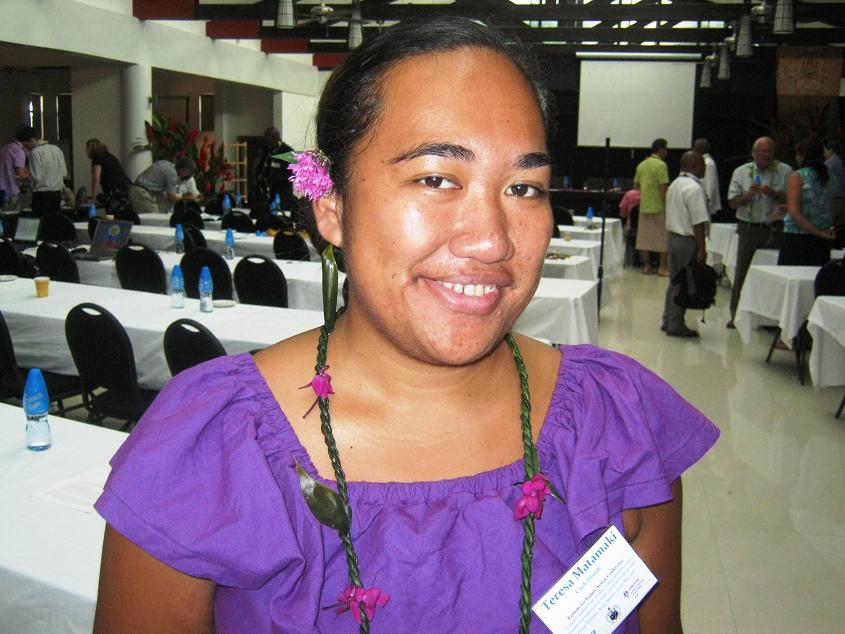
Mii Matamaki – Cook Islands


“I think it will be the people right at the community level, where there’s a lot of confusion about what climate change is causing. Climate change is sort of distinguishing changes in our environment. As technical people sometimes concepts is hard enough for us to understand them, so they’re [community level] the ones who really need that information.”

Emmajil Bogari-Ahai – Papua New Guinea


Climate Change Lessons Learnt for Future Action Conference


Mona Ainu'u - Broadcasting Corporation of Niue

23 May 2011, Apia, Samoa - The start of the “Lessons for Future Action Conference” in Apia today heightened the urgency to address issues of climate change adaptation and future decisions affecting Small Island Developing States (SIDS).

The threat of natural disasters is becoming increasingly clear both in terms of their impact on SIDS, and of their personal vulnerability. A strong message during the opening ceremony was the need for immediate action, in cooperation with others, as we cannot do it alone.

Prime Minister of Samoa, Hon. Tuilaepa Sailele Malielegaoi

The Prime Minister of Samoa, Tuilaepa Sailele Malielegaoi, opened today’s conference calling upon participants to share the lessons learnt so we can strategise for a better future in the face of climate change.

“What is needed now in the pacific and elsewhere is more climate change project implementation, and this is the single most important action for the future, I will urge you therefore as stakeholders of climate change and disaster risk management to share the lessons learned to date”.

The issue of partnership was echoed by Mr. David Sheppard, Director of the Secretariat of the Pacific Regional Environment Programme (SPREP). He shared SPREP’s continuing focus of strengthening partnerships and the critical need to work together without competition or duplication.
Mr David Sheppard, Director of SPREP

“We have limited resources and capacity, so let’s work together and better utilize resources and avenues that have been established-both within and between our regions”.


“While there are differences between and within regions in terms of size, capacity, levels of development and geography, I have always been impressed by the level of solidarity and cooperation that exist between small island states. This is exemplified by the work of the Alliance of Small Island States, AOSIS”.

The Prime Minister of Samoa also reiterated the support the Small Islands Developing States (SIDS) needs from the international audience.

“One of the biggest challenges as you all know has been to get the voice of Alliance of Small Islands States member countries heard. We collectively want a 45 percent reduction in greenhouse gas emissions by 2020 based on 1990 levels. I think we may now have the man power and the skills to fund the determination and the technological means to achieve this”.
 
James Bartley, Deputy Director General of AUSAID
James Bartley, Deputy Director General of AUSAID acknowledged the importance of productive means to assist the Small Island Developing States (SIDS).

“The issue is not simply one of the amount of resources available to address climate change around the world, there‘s a real issue of how effectively those resources are used most efficiently, most productively and indeed in ways that are not counterproductive”.


Over the next four days participants will deliberate over a range of different issues including capacity development, strategies and on-ground options, community based responses to climate change adaptation and disaster risk reduction as well as information and awareness raising. By sharing the lessons learnt in these areas during panel discussions and presentations, it is hoped a path forward will be forged.
The meeting is a partnership between the Australia Government Department of Climate Change and Energy Efficiency AusAid and the Secretariat of the Pacific Regional Environment Programme (SPREP). It is hosted in Samoa from 23 to 25 May.