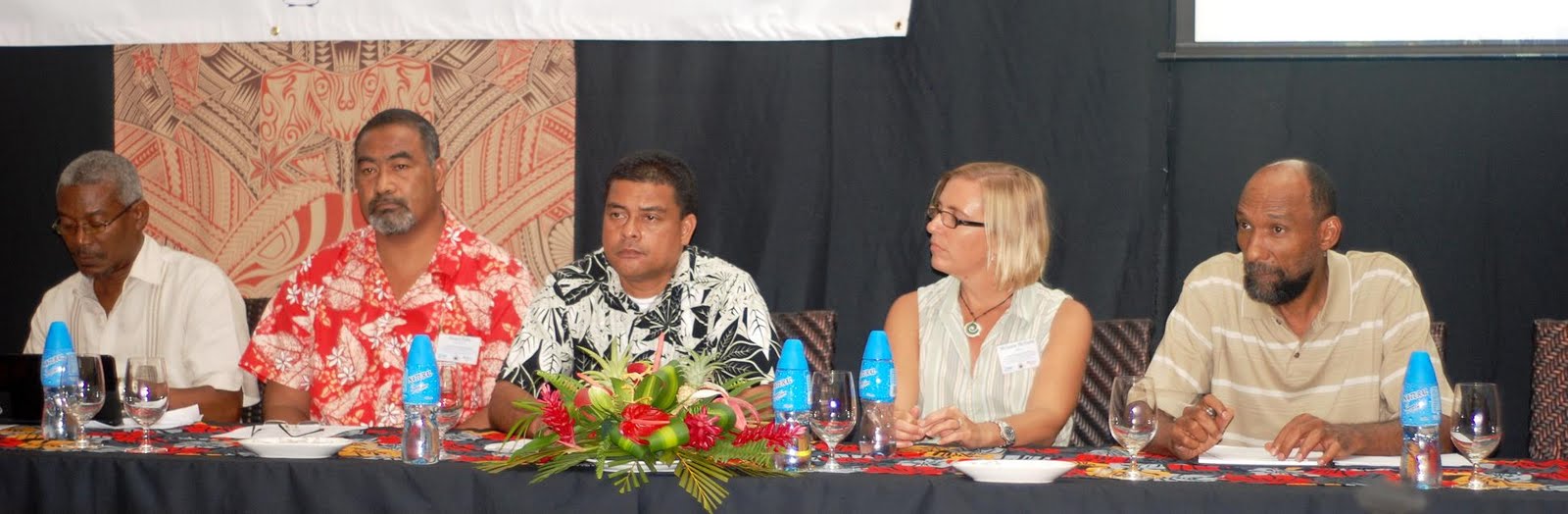
The four day conference has brought together practitioners, policy makers and researchers from the Pacific, the Caribbean, and the West Indian Ocean to examine how lessons learned today can inform climate change adaptation and future disaster risk management in Small Island Developing States.
The following information is coverage of presentations publicized from the first three days of the conference.
Click on the highlight text to view the presentations.

1. Information and Awareness Raising
Chair: Roger McLean, IPCC Lead Coordinating Author, Small Islands
Topics of presentations:
- Awareness raising – understanding the risk
- Community perceptions of and responses to climate change and risk
- Baseline data needs – what we need to attribute climate change
- Underpinning science and modeling tools
- Communicating the science
Baseline Data Needs For Climate Change Attribution Studies, Leonard Nurse.
What Science is needed or must be provided to facilitate Information and Awareness Building? Michael Taylor.
Information and awareness raising, Paul Hopler

2. National Planning and Policy Frameworks
Chair: David Sheppard, Director of the Secretariat of the Pacific Regional Environment Programme [SPREP]
Topics of presentations:
International and regional frameworks, national policy and planning frameworks
- Do national policy and planning frameworks meet emerging needs?
- Do national policy and planning frameworks meet emerging needs?
- Developing nationally relevant policy frameworks for CCA and DRR
- What role does CCA and DRR play in core policy development?
DRR and CCA synergies and opportunities at the national level
- What have we learned from joint national planning?
National Planning and Policy Framework: Lessons from the Caribbean, presented by Ken Leslie
CCA and DRR IN SIDs Lessons for Future Action Conference, Netatua Pelesikoti

3. Community Based Responses to CCA and DRR
Chair: Frank Wickham, Solomon Islands
Topics of presentations:
Application of demand driven and bottom up experience and planning
Sustainable development and building resilience for DRR and CCA (including adaptive capacity and traditional responses)
DDR and CCA synergies and opportunities at the local level (including lessons learned from joint national planning)
Linking national planning to local and sub-national levels
- Scaling up to national, regional and global support
- Sustainability considerations of CCA and DRR
Sustainable Development and Building Resilience for DRR and CCA, Sione Faka’osi
Exemplars of Resilience, Monifa Fiu
Linking national planning to local and sub-national levels Scaling up to national, regional, and global support, Indi Mclymont-Lafayette
Strengthening Adaptive Capacity in Choiseul, Solomon Islands, Robyn James
 4. Strategies and On-Ground Options

Chair: Leonard Nurse, IPCC Lead Editor for SIDS
Topics of presentations:
What works on the ground
- Effective adaptation options – what’s the best way to provide support?
- Sectoral approaches to risk management
- Adaptation/Renewable energy opportunities
- Actual experiences with CCA and DRR – challenges and opportunities
What combination of CCA and DRR deliver the most benefits? (public/private partnerships, those that integrate DRR, CCA and economic development, community involvement)
Pacific Conference of Churches on Climate Change Adaptation and Risk Reduction, Rev. Ikani Taliai Tolu
Lessons learn, and progress to date, Simpson Abraham
Climate Change Strategies, In-water Options, Melanie McField

5. Capacity Development
Chair: Edward Green, Caribbean Community Climate Change Centre
Topics of presentations:
What is capacity development and how is it best developed?
Regional responses and needs of the smallest countries
Developing business plans and project proposals
Accessing resources
Lessons for Future Action Conference, Franklin McDonald
Observations on change, disruption, and challenges, Frank Wickham
Climate Change Resilience, Oxfam/Care
Regional Response and Needs of Small Islands, Leonard Nurse

6. Lessons for Future Action
Chair: Rob Kay, Coastal Zone Management (Australia)