Friday, 9 September 2011

Lessons for Future Action Summary Outcomes

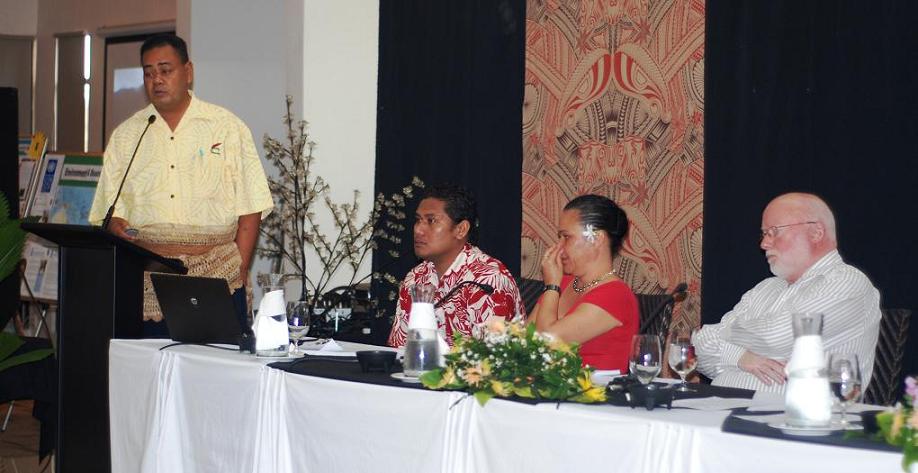
The Summary outcomes of the "Lessons for Future Action Conference" held in Apia, Samoa this year is available for download.


To read more about this conference that brought together Small Island Developing States (SIDS) from the Pacific, Caribbean and Indian ocean, please visit our newsletter from Day 1 of the conference.  This will lead you to other news, information and photos from the event.


Saturday, 23 July 2011

Pacific youth want their governments to commit and act now on Green economy

By Clive Hawigen, cliveh@sprep.org

22 July, Apia, Samoa - “The Pacific does not need to wait for a global meeting to commit to sustainable development in a green economy. “

Ewan Cameron, Pacific Youth Representative and 350.org Pacific Moving Planet Coordinator, said in a statement circulated to the Pacific Ministers during the joint Ministerial Meeting of the Rio + 20 preparatory meeting held at the Tanoa Tusitala Hotel in Apia, Samoa.

Representing the Pacific youths, Mr Cameron said: “We humbly ask that you allow your youth to contribute towards policy making decisions as we have a sense of ownership and responsibility to our countries, our families and our environment.”

He said sustainable development is the clear solution to meet the environmental challenges, but it was slow in coming and the youths of the Pacific were hopeful that the Rio+20 will be setting that reevaluates the global commitment and bring about a Green Economy in a Blue World, especially for us in the Pacific as it would benefit us all.

Mr Cameron further stated that they deserved a legacy of a strong environment, one that has helped nourish and protect our ancestors and would continue to shelter and embrace our children and our children’s children.

He said Pacific youth support the strong negotiation positions that reflect a low carbon future and sustainable energy practices through renewable energy, in the effort to lower CO2 concentration levels and also recommended that Green taxes and budget reforms also be considered and implement.

Youths also proposed that investment in education capital at a young age to develop capacity be included as a pathway to a Green Economy and request an increase in scholarship opportunities for Pacific islanders where there a gaps in the technical areas.

“We ask you to involve the communities in educational awareness, so that a holistic approach is taken as part of the Investment in Education Capital to bring about change in behavior.” We the youth stand before the governments of the Pacific and offer our support in whatever way needed to achieve a Green economy in the least amount of time possible,” he said.

Your say:  How can Pacific youth contribute towards greening an economy?

"What I personally feel is that it is vital that we recognise that skills are not only passed through formal education modes and in saying that, education plays a significant role in linking knowledge to change and linking actions for sustainable development. I think that over the years there’s been assumptions made that when we talk about sustainable development, they are best described through formal education mode. There’s a need to have a balance and also valuable of traditional knowledge and the richness of inter-generational conversation and knowledge sharing processes.  In this process I see that it is critical to involve young people and this process where traditional knowledge is passed down from elders to young people and so that young people, which is in line to formal education systems is a threat to young people in the sense that the traditional component or the traditional knowledge is lost and I think that there needs to be some merger between building in traditional concepts and traditional knowledge and using these with what young people have gain through schools through the formal education system and in saying that I think that young people have a critical role in building a prosperous future for us here in the Pacific." Morena Rigamoto – Live and Learn Environmental Education (FIJI)


"Youths can participate in community activities that will assist in mitigating and adapting for climate change, they can also be supportive to and be involved in a lot of activities that help them to become better leaders of the future and also understand the role that they have in terms of developing policies and having an input into policies that’s going to affect future generations."  Lili Tuioti – Tokelau Department of Education
 

"Yes I think youths can do a lot of activities to contribute to the green economy at the community level. Because in my country, we target all civil society, NGO’s, youth, church group and youths can contribute on basic and community base projects around where they can collect data." -
Asipeli Palaki, Department of Environment Tonga


"Youths can help towards implementation of greening the economy especially in educating their peers. A great example would be peer to peer education and probably advocating whatever messages that needs to be put across. As of this year, more than half of the population of the Pacific are under the age of 24 years, so a great deal of this would be educating them and advocating the message that come out from this meeting." - Maseikula Niumataiwalu, Youth Representative, The Econesian Society
 

"I think the youth as the power to do all the work but they just need guidance so that they don’t cross over boundaries and violate laws. Peer to peer spreading of information and educating people and I think they’ll bridge the gap rather than having government officials go in or people from offices go in and teach the communities because they sometimes don’t take it really seriously but the youth can actually help on that. They can bridge the gap in educating people and it’ll be more effective." - Lucille M. Sain, Youth representative, Federated States of Micronesia


Friday, 22 July 2011

Your say: What are the concerns of the Private Sector and the communities in respect of greening businesses and markets?

Clive Hawigen, cliveh@sprep.org
21 July 2011

“We believe in the benefits of greening businesses, however you need to see the balance when you’re pursuing green business with the cost that will be incurred in getting technology that is environmentally friendly, the production that may have to take place and of course in order to get products that are organic, you have to go through a process – all of that comes with a cost. At the same time there are actions that have been taken, for example with developed countries one of their key strategies is to lower carbon emissions through imposing a carbon tax. By doing this, it has an impact on the airfares of people travelling here, for example people travelling from England to our region. This can mean a reduction in our tourist market and of course tourism is a big industry in the Pacific.” - Ms Mereia Volavola, Pacific Islands Private Sector Organisation


“I think some of the concerns raised this morning are very valid. First of all, the issue of financing, of going green but I think when you say financing, it needs another element and it needs policy. It’s not necessarily you need a big financing but small changes within your organization to start going green. Investing, for example all this time you’ve be serving lunch to your eco tourist clients by giving them this Styrofoam lid cover for lunch boxes, why not get these reusable plastics, doesn’t cost much but it’s there. So I think from the governments point of view is yes they need financial support but at the same time government needs to develop policies that could slowly make changes, not a very drastic change, but as time goes on the business will change their behavior. Secondly coming from the government point of view is that yes we want green but for small island states, costs will still be high for the national government so it’s a balance that some countries have to make compared to the other countries who have big land and have the luxury of time. Palau doesn’t, Palau needs to act now because we’re a small country.” - Joe Aitaro, Government of Palau


“What we are doing in the country is to use the whole government approach where we deal with the sectors but deal with them in parallel with the others because we don’t want to leave the agriculture sector behind from, let’s say, mining because we see them all as important sectors because of economy development. But when it comes to green economy, we are looking at how sustainable are these private players in the whole issue. Basically, what we want to look at is maybe the private sectors coming up with their agendas of how they see and understand the green economy. Communities also need to participate by telling us how they see the green economy to be workable in the Pacific and looking at the churches which tries to blend all these - the private sector and communities into a process and church can be a vehicle for implementing this. In Papua New Guinea what we are doing now is trying to take this environmental sustainability agenda by mainstreaming into the whole sector and we’ve got two main objective. One is to do with climate change adaptation and the other is on environmental sustainability so we try as much as possible to use the one government approach.” - Kumaras Kay Kalim, Papua New Guinea Department of Environment and Conservation


“The private sector would like very much to see that in greening the economy it has benefit to the private sector instead of having a burden on the private sector. So, to go about helping the private sector in to go on with their business, they are suggesting for the government to fund the outcomes for green economy so they can start greening the economy on whatever business they are doing. As I said before is that greening the economy to benefit them rather than being a cost to them. They have looked and done things in terms of energy efficiency, that there’s funds for actually put in place where they can reduce the cost of electricity bill which some of them have done.

So what we need to do from a perspective of a forum like this is to draw and learn from what they are doing so that we can learn better than what we are doing now. Their message is very simple and that we have to go back to the communities and see what the communities are doing in the villages and learn from them and that will teach us how to do better. One of the interesting things that the Pacific Council of Churches mentioned is that although we are talking about green economy, their perspective is that green economy is more or less talking about the private sector economy, the formal economy, whereas high percentage of the economy in the Pacific are informal economy so how do you apply green economy which you would apply in a formal economy to an informal economy? We have to look at it very carefully to apply economic concept which are appropriate for the informal economy so that we can have a better sustainable development in the island countries because up to 80% of the Pacific Island economy is informal economy.” - Henry Taiki – Programme Officer – WMO


Thursday, 21 July 2011

Your say: Can a Green Economy benefit the Pacific?

By Clive Hawigen cliveh@sprep.org
20 July 2011, Apia Samoa


"Sustainable development is a much overused word and it’s been so overused, I think it’s lost any meaning it might once have had. What is clear for the Pacific Islanders is that they depend totally on the resources of the ocean and in order to have sustainable livelihoods they need an ocean that is healthy, which means that it needs free of any climate change impacts. This means fish stocks need to be sustainably managed and not overfished and it also means that local communities can have access to the resources in which they depend and have a proper say in their management." - Michael Donoghue, Executive Director Pacific Islands Program for the Conservation International

"It’s important because we here in the Pacific, we really dependent on the ocean and thus far many of the proposals made at the global level only pay rhetorical tributes to the contributions that the oceans bring to the environment and to our economies so blue economy, for us is an important approach and I think that’s why Pacific Island countries should be more attuned to the details of it and to be promoting it wherever it can especially in the lead up towards Rio+20 next year." - Fei Tevi, Pacific Council of Churches

 "The way I look at it, a green economy is basically the blue economy, but for the Pacific Island Countries there is really on what we have, which is the blue economy.  A lot of our focus at least on the Rio +20 process should be on what we have, the ocean, the fisheries so as I mentioned this morning we need to get more benefits from what is taken out of our waters.  That’s one way of benefiting from the green or blue economy whatever way you want to say it." - Jeem Lippuwe,  Federated States of Micronesia’s Ambassador to the UN


"I think the Pacific Island has the biggest ocean on earth therefore it has most of the ocean or marine resources available.  With that in mind it is very important for small Pacific Island countries to think of ways that can help them sustainably manage these resources because they have been depending on this for years and years to support their livelihood. I think it’s very important for Pacific Islanders today – this concept of green economy and for them to try and also think about sustainable practices or ways that can be used to manage their oceans and most importantly the resources that are available in the Pacific Ocean.  However, having saying that I must say that there are challenges as well for Pacific Islands to achieve this goal. We know we are very limited with a lot of things like funding, limited with human resources or expertise especially in helping to manage the resources that are available in the Pacific Ocean. We are also limited with capacity building and these are real challenges. It’s easy to say it but when you try to put it in real practical terms it’s going to be very difficult for the Pacific Islands so I think it’s a new concept but I think Pacific Island should all work together to come up with clear strategies or methodologies and with technologies that can be used in the region to apply the green economic concept, in this case managing the Pacific Ocean and its resources." - Trinison Tarivonda, Department of Environment, Vanuatu

Pacific discussions towards a green economy begins

20th July 2011, Apia, Samoa – The Pacific discussions on green growth commenced today with an Open Forum which aims to promote discussion and awareness of the issues that surround the theme of Rio+20, “green economy in the context of sustainable development and poverty alleviation”.


The Forum was officially opened by Samoa’s Minister of Natural Resources and Environment, Honourable Faamoetauloa Lealaiauloto Taito Dr Faale Tumaalii, who stated that the “ meeting is a timely welcome and opportunity for us, as decision and policy makers, to discuss the strengthening of multilateral environment governance to make it more reflective of the 21st centuries challenges and realities.”


The forum which is a prelude to the Joint Ministerial meeting will feature presentations and discussions around the five pathways for green growth and its relevance for the Pacific, (i) Investing in natural capital; (ii) Promoting sustainable infrastructure; (iii) Greening business and markets; (iii) Promoting sustainable production and consumption patterns; and (v) Promoting green fiscal and taxation policies and budgetary reforms. In essence the pathways constitute a strategic formula for achieving the transition to a green economy and sustainable development.

It is also an opportunity to engage a wider platform through governments, local and regional NGOs, regional and international organisations, to take stock of the progress towards achieving sustainable development, as well as to highlight implementation gaps, challenges and constraints unique to the Pacific.

“We should not be bogged down by technical discussions on what is green economy, what’s important is for us to focus on the implementation of activities on the ground in order to improve sustainable development and eradicate poverty,” said Mr Kosi Latu, Acting Director of SPREP.

The deliberations and discussions from the two day forum will culminate in common outcomes which will be submitted to the Joint Ministerial meeting for consideration.

“We hope that the Open Forum will provide us with a common understanding of how “greening” the economy offers a concrete and additional measure or pathway for achieving sustainable development.” stated Mr Iosefa Maiava, Head of UNESCAP Pacific Office.

The Open Forum included project field visits and public displays to promote green economy materials and projects. Field visits to “green” projects were conducted in the afternoon to show practical examples of how greening at different levels can be achieved with positive results in a number of areas; waste management, renewable energy, food security and income generation.

The Open Forum is scheduled from 20 – 21 July and will precede the Ministerial meeting on Friday 22 July 2011.

For further information and to request interviews please contact:
Ms Elisapeta Kerslake Phone: +685 7523670 Email: elisapeta.kerslake@one.un.org
Ms Tuiolo Schuster Ph: +685 23800 Email: tuiolo.schuster@mnre.gov.ws
Ms Nanette Woonton Ph: +685 66 305 Email: nanettew@sprep.org
 

Wednesday, 8 June 2011

Photo collection from the Lessons for Future Action Conference


You are invited to view Ewan Cameron's photo album: Lessons for future action photo file 1
Lessons for future action photo file 1
Apia, Samoa -
May 26, 2011
by Ewan Cameron
Message from Ewan Cameron:
copy and past to the blogspot
To share your photos or receive notification when your friends share photos, get your own free Picasa Web Albums account.


You are invited to view Ewan Cameron's photo album: Lessons for future action photo file 2
Lessons for future action photo file 2
Apia, Samoa -
May 26, 2011
by Ewan Cameron
To share your photos or receive notification when your friends share photos, get your own free Picasa Web Albums account.


You are invited to view Ewan Cameron's photo album: Lessons for future action photo file 3
Lessons for future action photo file 3
Apia, Samoa -
May 26, 2011
by Ewan Cameron
To share your photos or receive notification when your friends share photos, get your own free Picasa Web Albums account.


You are invited to view Ewan Cameron's photo album: Lessons for future action photo file 4
Lessons for future action photo file
Apia, Samoa -
May 25, 2011
by Ewan Cameron
To share your photos or receive notification when your friends share photos, get your own free Picasa Web Albums account.


You are invited to view Ewan Cameron's photo album: Lessons for future action photo file 5
Lessons for future action photo file 5
Apia, Samoa -
May 25, 2011
by Ewan Cameron
To share your photos or receive notification when your friends share photos, get your own free Picasa Web Albums account.


You are invited to view Ewan Cameron's photo album: Lessons for future action photo file 6
Lessons for future action photo file 6
Apia, Samoa -
May 25, 2011
by Ewan Cameron
To share your photos or receive notification when your friends share photos, get your own free Picasa Web Albums account.


You are invited to view Ewan Cameron's photo album: Lessons for future action photo file 7
Lessons for future action photo file 7
Apia, Samoa -
May 24, 2011
by Ewan Cameron
To share your photos or receive notification when your friends share photos, get your own free Picasa Web Albums account.


You are invited to view Ewan Cameron's photo album: Lessons for future action photo file 8
Lessons for future action photo file 8
Apia, Samoa -
May 23, 2011
by Ewan Cameron
To share your photos or receive notification when your friends share photos, get your own free Picasa Web Albums account.


You are invited to view Ewan Cameron's photo album: Lessons for future action photo file
Lessons for future action photo file
Apia, Samoa -
May 24, 2011
by Ewan Cameron
To share your photos or receive notification when your friends share photos, get your own free Picasa Web Albums account.


You are invited to view Ewan Cameron's photo album: Lessons for future action photo file
Lessons for future action photo file
Apia, Samoa -
May 23, 2011
by Ewan Cameron
To share your photos or receive notification when your friends share photos, get your own free Picasa Web Albums account.


You are invited to view Ewan Cameron's photo album: Lessons for future action photo file 10
Lessons for future action photo file 10
Apia, Samoa -
May 23, 2011
by Ewan Cameron
To share your photos or receive notification when your friends share photos, get your own free Picasa Web Albums account.


You are invited to view Ewan Cameron's photo album: Lessons for future action photo file_1
Lessons for future action photo file_1
Apia, Samoa -
May 24, 2011
by Ewan Cameron
To share your photos or receive notification when your friends share photos, get your own free Picasa Web Albums account.


Closing the Lessons for Future Action Conference


Closing statement by Mr David Sheppard, Director of the Secretariat of the Pacific Regional Environment Programme (SPREP) at the Lessons Learnt for Future Action Climate Change Adaptation Conference, 23 – 26 May, Apia, Samoa

Conference delegates, friends

I’m very pleased to offer some closing remarks to this important and very successful conference.

On Monday, I mentioned that we have gathered the “cream of the cream” in this room in relation to expertise on climate change and disaster risk reduction in small island states. This has been borne out by the quality of presentations and discussions during the week.

Given this wealth of expertise, I also mentioned that SPREP may even try to keep you all here and not let you go back home.

Even if that is not possible – unfortunately and reluctantly - I am sure all of you have been impressed by the great natural beauty of this country, the warmth of its people and the professionalism of approaches to address climate change and other issues.

I think this is best summed up by Janet Larue this morning in discussing one of the conference field trips when she said: “I love Samoa”.

We do too.

I hope many of you are planning a trip back to Samoa – if you do return please consider SPREP as your home away from home – our home is your home – our fale is your fale.

I urged everyone on Monday to be open and generous in sharing our experience and to learn from one another. This objective has been exceeded and I think we have all definitely learnt from each other. Jo mentioned this morning that a particular point from one of the working groups was “a great bit of wisdom”. In fact I think we have heard “many great bits of wisdom” this week and I am sure they will be well captured in the conference report.

This will be a very important and landmark document.

This conference has underlined that there are differences between our regions but there are in fact many more similarities, particularly in terms of the challenges we face and the approaches we are taking. As Leonard Nurse said this morning, “there are many positive things happening in our regions”

From my side I have learned a lot from listening to and talking with colleagues from the Caribbean and Indian Oceans. I will ask SPREP staff to consider how these suggestions and lessons can be best applied in the future development of climate change programmes at SPREP, and in the Pacific region.

Robert asked each of us this morning to consider what we would like as an outcome from this conference.

My answer was - concrete action to ensure this conference is followed up.

We have heard a number of concrete suggestions for follow up from this mornings’ session and a number of practical suggestions are included in the Outcomes Statement from this conference.

Ken Leslie and I will be signing a Memorandum of Understanding today between SPREP and 5 Cs. This is a very important document and a major step towards better information sharing and practical cooperation between the Pacific and the Caribbean.

I am sure this partnership will also provide a useful vehicle for following up many of the key recommendations from this conference. SPREP is really looking forward to working with the 5Cs to implement this MOU and we hope this cooperation can be expanded in the future to include the Indian Ocean region as well.

Ken told me the idea of this conference, bringing together key people from the Caribbean, Pacific and Indian Oceans was floated by him about 4 years. It has been great to bring this about and we look forward to the next conference - hopefully we will not have to wait another 4 years and we look forward to meeting in the beautiful Caribbean.

Ken – thank you for your leadership, and perseverance, in bringing this conference from an idea to reality.

This conference has been rich in content. Jo Mummery and her team have provided a masterful summary of key insights which has been well refined by the excellent reports from working groups this morning.

To briefly highlight some key messages I will take from this conference.

First the benefits of working across regions and ensuring there are better mechanisms put in place for sharing experience in the future. We have more work to do on this area. This works to the benefit of us all and can be done easily and quickly.

Second the need to be flexible and look at new ways of working. Climate Change poses many new and different challenges and we need to look at different approaches to how we carry out our core business. By necessity this must involve working across sectors and encouraging and better applying innovation in our work.

Third we must focus on better and more strategic partnerships. We must avoid a silo approach to working. In the Pacific, SPREP is committed to working more collaboratively with other Regional Agencies, particularly with and through the CROP CEO’s Task Force on Climate Change, as well as working better with civil society. This conference has also provided an excellent platform for expanding partnerships between the Caribbean, Pacific and Indian Oceans. We now need to ensure this translates to action.

Fourth I would emphasise the issue of sustainability which is vital if we are to better address the many challenges of climate change. This is implicit in our discussions this week on moving from a project to a programme approach, ensuring more long term and sustainable sources of finance, and developing stronger and more effective institutions for climate change. This is also closely linked with the issue of strategic leadership – at all levels - as clearly outlined by Edward Green in his closing remarks yesterday.

Fifth, and finally, there are some very specific key messages from this conference. I awoke on Tuesday morning to the thought resounding in my eardrums that: “The climate has changed, the climate will change, and the climate demands change”. So this is one message that not only resonates but has stuck. Thank you Michael Taylor for this insight.

In closing I would like to thank a number of organisations.

The Government of Australia, and particularly the PASAP Programme, for its most generous support for this conference. We have all appreciated the guidance and wisdom of Martin and Jo and the hard work and dedication of Liz and Cameron throughout the week. Thank you. We really value having the PASAP team at SPREP and feel this is a real win-win situation. This underlines the practical and tangible benefits of partnership.

Thank you again to the Government of Samoa for excellent support throughout this conference and, once again, for the very generous hosting of SPREP in your beautiful country.

Thank you to the SPREP team for your hard work and support. I am honored to lead such a professional and hard working team.

Thank you to all the hard working staff at the Tanoa Tusitala – we have appreciated your hard work and smiles throughout this week.

Finally, I would like to invite you all to at SPREP tonight and wish you all a safe trip back to your home countries.

Thank you again and I would like to declare this very important and significant conference closed.