Thursday, 11 July 2013

Cook Islands reaps benefits of CC and DRM integration

By Evan Wasuka, Editor of Pacific Media Team, 2013

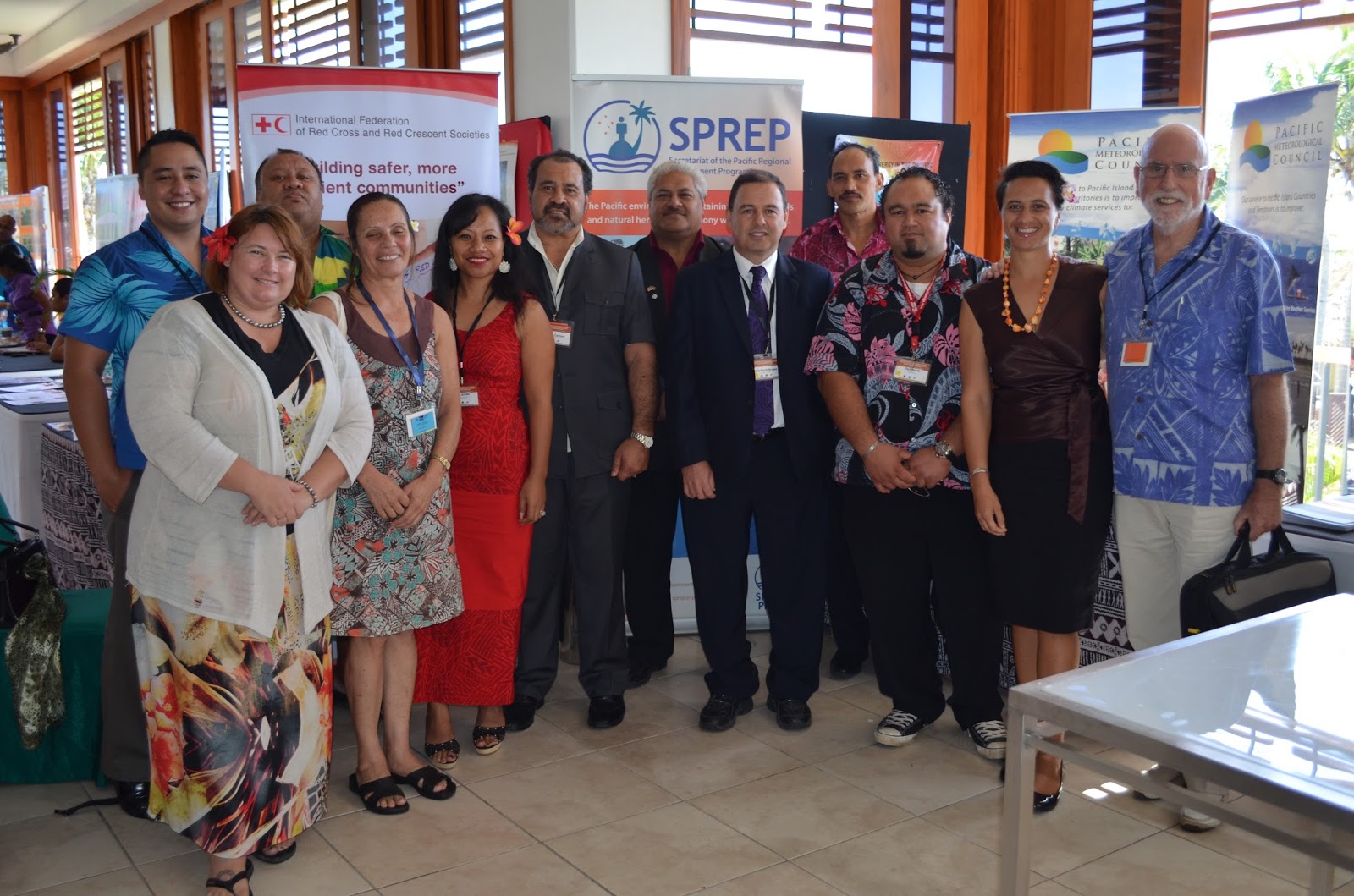
Cook Islanders at the Joint Meeting of the 2013 Pacific Platform for Disaster Risk Management and Pacific Climate Change Roundtable with Finance Minister Hon. Mark Brown.


11 July 2013, Nadi, Fiji - While the integration of disaster risk management (DRM) and climate change (CC) has been the key topic on agenda at the Joint talks in Nadi this week, one country that is already putting this into practice is the Cook Islands.

Both its Emergency Management service and its Climate Change Office are under the Office of the Prime Minister.

The Director of Cook Islands Emergency Management, Charles Carlson says the main benefit has been the maximising of limited resources to get maximum outcome.

“By having both under one division we work regularly together, we meet every couple of week so we know what is going on in climate change and they know what is happening in disaster.

“There is no duplication of services. We complement what they are doing.”

Carlson says he hopes that the Joint Meeting this week has removed any doubts about integrating CC and DRM.

“After hearing the presentations hopefully that message will get down to all DRM and CC practitioners about the importance of working together.”

As for the Cook Islands, Carlson says the way forward is to integrate climate change and disaster into other sectors.

“For example with infrastructure, we have to make sure that climate proofing is part of the building code and ensure when buildings are built it is climate proofed for the future. So we address resilience in the longterm.

“Or in the area of health, climate change has to be taken into account.

Carlson says the main issue in the Cook Islands is to get key stakeholders aware about CC and DRM, and to take this into account in their planning.

“Climate change is not just an environmental issue, it’s a development issue.”

Carlson says the Joint Meeting has been helpful in bringing together a wide range of sector to discuss integration.

“Ideally what each country should do is have their own national platform, to look at how climate change and disaster can be addressed in core sectors. CC and DRM then becomes everybody’s responsibility.”

Way forward for Samoa

By Asenati Taugasolo Semu, Press Secretariat of the Government of Samoa: http://www.savalinews.com


11 July 2013, Nadi, Fiji - Addressing the real needs of the countries and their people is the way forward for Samoa to deal with climate and disaster related issues.

This was according to the Acting Chief Executive Officer of the Samoa Ministry of Natural Resources and Environment, Filomena Nelson during her presentation at the Joint Meeting of the 2013 Pacific Climate Change for Disaster Risk Management & Pacific Climate Change Roundtable this week.

Nelson highlighted her country’s perspective for the United Nations Framework Convention on Climate Change (UNFCCC) and Linkages to the Roadmap.

One of the suggestions raised by Nelson is to maintain status quo - separate regulatory and institutional or governance frameworks but recognise synergies through implementation.

She also pointed out the engagement of more private sector and non governmental organisations.

“We should address real issues, resettlement and relocation of extremely vulnerable communities,” said Filomena.

“We should address synergies and commonalities and to focus on the risks when addressing these synergies.

“There should be clear roles and responsibilities of regional organisations and donors,” she said.

“Although disaster risk management and climate change have synergies, but there are also major differences in response arrangements and the fact that not all disasters are caused by climate related hazards.”

Nelson said some challenges that should be implemented in the roadmap are coordination by respective sectors, communication among agencies, sharing resources and knowledge and most importantly assessing funds.

She suggested that the implementation of climate change and risk reduction adaptation and mitigation strategies should be prioritised.

“This includes climate early warning products, promoting agro forestry, first aid and search and rescue response capability.”

“She said response capability should be provided to villages within forest fire prone area and also early warning capability through fire sirens, first aid and search and rescue response capability.”

Tonga’s Deputy Prime Minister wants to merge climate and disaster functions

By Sini Latu, Tonga Broadcasting Commission: http://www.tonga-broadcasting.net


11 July 2013, Nadi, Fiji - One of the ways forward in dealing with climate and disaster related issues in Tonga is bringing the related divisions together under one ministry, says Tonga’s Deputy Prime Minister Samiu Vaipulu.
 
Vaipulu says after three days of dialogue at the Joint Meeting of the 2013 Pacific Platform for Disaster Risk Management and Pacific Climate Change Roundtable in Fiji, he is contemplating the merger of the Environment, Climate Change, Tonga National Meteorological and National Emergency Management Office into one ministry.

Vaipulu says he will raise this proposal with the Prime Minister and Cabinet.

“My reason to merge these divisions – is to be able to gain more funding, aid and help. If these divisions are merged – they could be able to work more closely together for the benefit of the country and its people”, says Vaipulu.


These divisions are under different ministries at the moment – which makes it hard sometimes to direct certain task, as one may say, that particular task is under their division, says Vaipulu.


The idea was from the joint meeting of the Pacific Platform for Disaster Risk Management and the Climate Change Roundtable – which he says has shown the way forward in addressing Climate Change and Disaster issues.


According to the deputy prime minister - the Special Representative of the United Nation Secretary-General for Disaster Risk Reduction – Margareta Wahlstrom had promised that if Tonga approves this – she will return to the Kingdom to see what they can do to help.


Bringing these divisions together will make work easier says Vaipulu and “funds and help from donor partner will be used wisely”.


He called on donor partners to work closely with the government.


“Donor partners should not come and tell us what they want to be done, but instead we will work together to lay out the best plan, taking into consideration the future.”

Is the Pacific doing enough in its disaster early warning systems?

By Daniel Namosuaia, Solomon Star: http://www.solomonstarnews.com


11 July, 2013, Nadi, Fiji - A lot of progress has been made in the Pacific in the area of early warning systems (EWS), however more needs to be done, says Rajendra Prasad, the UNESCO/IOC Programme Officer for DRR and Tsunami Warning.

Prasad says countries in the Pacific do vary on their level of EWS, but says the progress and developments done within the region has been going reasonably well.

“there are several natural hazards such as tropical cyclones, flash floods, droughts and tsunami which each country’s state of EWS differs. But for us in Fiji, we have reasonably good early warning systems for tropical cyclones,” Prasad said.

Although there were some weaknesses such as incidences of over warnings, under warnings, late warnings or too early warnings, Prasad said it has been a real challenge for the Pacific with hazards like tsunami where information could reach the public through the media without proper assessment and causes panic and anxiety amongst people.

He stressed that for different hazards, different countries have their own EWS situation, some are well prepared more than others.

He highlighted that Solomon Islands is one of the countries that has one of the best EWS practices in place where the integration of the Meteorological services and National Disaster Management Office could respond in the earliest time to its EWS.

Prasad further highlighted that the Pacific has a long way to go in addressing certain hazards like that of tsunami, while with others like tropical cyclones, they are well equipped and have in place proper EWS.

However he said there is certainly a need for improvement to ensure EWS are in place to counter any type of hazards.

“We have a lot of way to go in terms of improvements on EWS but the good part is the Pacific Early Warning Centre will in the near future cease to issue warnings and people can get that quickly from their national met services and integrate that information with the national disaster divisions to organise the respond to EWS.”

He stressed that despite the challenges Pacific island countries face with the resources they have available, they have done a lot and this should be maintained and improved.

When asked on how prepared the Pacific is in terms of its EWS for natural hazards, Prasad said it depends entirely on the type of hazards.

He said if he is going to rank the pacific on scale of one to ten with ten being the highest, the Pacific would sit between 6 and 7.

However he said for tropical cyclones he would rank the pacific between 8 and 9. For flash floods he ranked it between 5-6 depending on the locality of the area and for tsunami, he ranked it below 5.

“This integration process (between climate change and disaster management) is like we are planting a seed and surely it will germinate and mature and bear fruit. Once it starts to grow, we will just have to look after it and by the end of the day it will enable us to tackle multi-hazards when it comes.”

Climate change to worsen risk on commercial agriculture

 By Ben Kedoga, NBC PNG
 
 
11 July 2013 Nadi, Fiji - A commercial agriculture project manager in Fiji says climate change will exacerbate risks to the industry.
 
Australian Center for International Agriculture Research, ACIAR, Fiji Papaya Project Manager, Kyle Stice said because of these challenges they are now trying to carry out research into natural disasters, so that a new strategy is developed to address the challenges created by the natural disasters.

Stice spoke on the issue of integrating climate change and disaster risk management in the agriculture sector. His presentation was based on a case study on the Fiji Papaya Project.


He said over the last four years natural disasters in Fiji have had a drastic impact, not only on the papaya farmers, but exporters as well.

Stice says it takes about 9 months for a papaya tree to bear fruit and within these four years the money made after the natural disasters, were used to offset the cost of damages and they have been left with a very unhealthy net income.

However, he said most of the Papaya farmers are also doing multi-cropping, in their farm, so they were able to generate some form of income, while waiting for the rehabilitation of their papaya farms.

Stice said their exporters were hardest hit by the recent natural disasters in 2012, especially those that are exclusively papaya exporters. He said their exclusive exporters lost business completely, including assets which they've acquired over time.

He said the current system put in place for disaster rehabilitation does not take into consideration such situations.

Stice said this illustrates that the commercial agriculture as an industry can be affected negatively by natural disasters.

He says the only way to minimise the negative effects of climate change is to plan for it.

"It is important that as businesses, whether you are a farmer or exporter that we start including the likelihood of a natural disaster into our planning, as farmers the way we manage our money, as exporters and the way we use our money so that we are not in a position that we are only relying on the government or an aid agency to come in and rehabilitate, so hopefully the industry is taking some of these messages on"

Stice added that the negative impact on the industry has also impacted on the confidence of farmers and exporters, and he predicted the numbers to drop.

"Unfortunately there's been a level of discouragement; we will see the number of farmers and exporters decrease because of these series of natural disasters at least for a few years, so confidence in papaya farming and exporting has dropped"

Wednesday, 10 July 2013

Kiribati builds resilience in water and sanitation sector through integration

By Sini Latu, Tonga Broadcasting Commission: http://www.tonga-broadcasting.net


10 July 2013, Nadi, Fiji - The Water and Sanitation Sector in Kiribati is supporting integration as a way of dealing with the impacts of climate change and disaster risk management.

Reenate Willie from the Kiribati Ministry of Public Works, says the Water Sector's role is to provide technical advice, monitoring and assessment, planning for resilience, supporting resilient communities and others.

Speaking at the Joint Meeting on Climate Change and Disaster Risk Management in Nadi, Willie said these roles also apply to climate change adaptation programmes.

“The water sector feels that there needs to be a combined approach on how to handle the critically linked areas of disaster risk, climate change, water, sanitation, hygiene and human health which is far more effective than individual sector approaches.”

He says the integrated approach also takes into account the fragility and sustainability of Kiribati water resources and health amongst other things.

Willie says the Water and Sanitation sector in Kiribati is limited in their capacity to implement some of the activities that have already been laid out in their policies and plans because they do not have the key people to implement them.

Kiribati also highlighted the need for flexibility in terms of funding support on climate change and disaster risk reduction activities.

With most of these activities carried out by communities, Willie says the water and sanitation sector is building the capacity of the community to become self reliant and sustainable.


Samoa’s climate proofed parliament

By Asenati Taugasolo Semu, Press Secretariat of the Government of Samoa: http://www.savalinews.com


10 July 2013, Nadi, Fiji - The redesign of Samoa’s parliamentary complex has been highlighted as one of the major examples of climate proofing in the region.

Environmental Expert, Professor John E Hay, cited the work on the Samoa’s parliament which focused on building at a higher level as an example of how infrastructure can be made resilient to the impacts of climate change.

“The problem is that the site where the parliament complex is located on the peninsula is actually an old split that had been reclaimed,” said Professor Hay.

“It is a very vulnerable location for the building itself.”

The main threat to the building says Hay is storm surges.

To make the building climate resistance, the ground level was raised so that the building is built at a higher level.

“We don’t only think about resilience for today’s conditions but also for tomorrow and the next decades.

“We need to increase the resilience of the structure of the infrastructure. If those services fail, there are huge consequences on the community and the people,” said the professor.

“The emphasis is on the fact that recovery and reconstruction may take two to three years. So while that take place, Samoa is on hold in terms of developments.

“Think about the individual that rely on the services from infrastructure that will estimate to be really fully recovered and replaced in three years.”

Funding for climate proofing of Samoa’s parliament was provided by the Australia as a gift to Samoa for its 50th anniversary.

Climate resilience infrastructure a must for Pacific Government

By Makereta Komai, PACNEWS


10 July 2013, Nadi, Fiji - Pacific Island Governments have been urged to insist that climate resilience be built into major infrastructure projects funded by development partners.

Professor John Hay, an AusAID consultant has just completed studies into two infrastructure projects in Samoa and Cook Islands.

In both cases C the re-development of the Samoan Parliament complex and the Avatiu Harbour in Cook Islands, the climate proofing costs are minimal.

“In Samoa’s case, climate proofing is less than five percent of the total cost of the project. One of the things coming out of our study now is that addressing these climate and disaster risks to infrastructure does not add a huge amount of cost to building new infrastructure or improving existing infrastructure.

The climate resilience cost for the Avatiu wharf was NZ$500,000, said Professor Hay.

Proposed changes to the Samoan Parliament complex to be funded at a cost of AUD$17 million by AusAID will have climate resilience built into it, based on the work carried out by Professor Hay.

“My advice to the government of Samoa was that there was extreme risk of tropical cyclone induced storm surge where the current complex stood. This is the major hazard that will test the building to the extreme in the next 50 years.

The Samoan Government was given two options C to protect the site through mangrove vegetation and to raise the building on a platform.

“The option that the Samoan Government has chosen is to raise the ground surface and then construct the Parliament building on this high level. What we found was that in terms of the costs, this is more cost effective than protecting the site, explained Professor Hay.

For Avatiu Harbour, storm surge, which is damaging the wharf building, was identified as a major issue that needed climate proofing.

“In the new design, they have raised the level of the wharf and the container storage area to take into account the projected higher sea level expected in the future and strengthened the foundation of the whole harbour to accommodate these very strong waves that potentially could destroy the structure.

Learning from the experiences of Samoa and Cook Islands, Professor Hay reiterated the need for governments to insist on climate resilience infrastructure that will withstand the impacts of climate change and disasters for the next 50 years.

“We want governments to have a strong resilient infrastructure. If that infrastructure fails, everyone is affected. Making sure that infrastructure is resilient is a responsibility of the government on behalf of its people, said Professor Hay.

The proposed redevelopment of the Samoan Parliament House is a 50 years gift from the government of Australia to the people of Samoa.

Fiji calls for carbon emitters to take responsibility


By Halitesh Datt, Fiji TV

10 July 2013, Nadi, Fiji - Fiji has once again called for major carbon emitting nations to take responsibility for their actions.

With climate change threatening the very existence of small island countries in the region, Fiji Prime Minister Commodore Voreqe Bainimarama says the Pacific is at the receiving end of historical activity by developed countries.

As a preparatory meeting for the 3rd International Conference of Small Island Developing  States got under way today, climate change will be at the forefront of discussions.
Commodore Voreqe Bainimarama- Prime Minister


With Pacific countries like Kiribati already preparing for the relocation of its people, Bainimarama says developed nations should assist the region in bearing the costs of such an exercise.
Commodore Voreqe Bainimarama- Prime Minister

Ends...

Small Island Developing States Meeting opens in Nadi, Fiji


By Halitesh Datt, Fiji TV

10 July 2013, Nadi, Fiji - In the build up to the 3rd International Conference on Small Island Developing States in Samoa next year, a preparatory meeting got underway in Nadi today.

Regional leaders and Pacific Island SIDS members are meeting on sustainable development issues, including climate change, poverty alleviation, human trafficking, and good governance.

The 66th session of the United Nations General Assembly set 4 objectives for the 3rd International conference of Small Island Developing States to be held in Samoa next year.

The meeting has to; assess the regions progress and gaps, seek renewed political commitment, identify new challenges and identify priorities.

Fiji Prime Minister Commodore Voreqe Bainimarama 

Commodore Bainimarama says the region should be bold in such discussions.
There is also a need for political will to push the region’s agenda at international level.

 Commodore Voreqe Bainimarama- Prime Minister 

The Alliance of Small Island States, AOSIS, says there is a need for a transformational paradigm shift on how the region engages itself on international front when it comes to our sustainable development.

Marlene Moses- Chair, AOSIS

This preparatory meeting culminates on Friday.

Ends...

Solomon Islands in good position to integrate disaster risk reduction with climate change

By Daniel Namosuaia, Solomon Star: http://www.solomonstarnews.com
10 July 2013, Nadi, Fiji - Solomon Islands is in a great position to integrate climate change and disaster risk management says the Director of Solomon Islands National Disaster Management Office, Loti Yates.

Yates said Solomon Islands has two key documents, one a national Disaster Risk Management Plan and Climate Change Policy.

“These two documents have put the country on the right path to integrating Disaster Risk Management with Climate Change Adaptation. However there are issues that need to be addressed to make this a reality.”

The NDMO director said Solomon Islands has a high chance of integrating these two structures despite the funding challenges it would face.

He said the disaster Risk Management Plan of 2010 has arrangements to deal with disaster risk and climate change adaptation.

And the climate change policy has indicated imperatives of aligning or integrating disaster risk management and climate change adaption.

He said currently they have two groups comprising of the national climate change team and the national disaster council which is like a barrier to the idea of integration.

But Yates said he sees no point of forming these two different groupings doing parallel work when the two groups are made up of much the same people.

“I believe it would be wise to have only one head for these two groups. Because at the end of the day when you talk about climate proofing or risk proofing development, it is about incorporating those agendas into how the work is done. And if we run parallel we will be duplicating work and using limited resources.”

Joint meeting looks to improve pacific climate change and disaster risk portal

By Daniel Namosuaia, Solomon Star: http://www.solomonstarnews.com


10 July 2013 Nadi, Fiji - Information and knowledge management for disaster management and climate change in the Pacific region is vital to combating climate change and disaster risk issues.

Despite the challenges Pacific island states and territories faced in accessing and acquiring important information, data and knowledge management, signs of progress have been made over the years.

With the creation of the Pacific climate change and disaster risk management portals, Pacific island countries can now easily access and share information through these frameworks to counter climate change impacts and disasters in the region.

This week experts from around the region have gathered to share the progresses and challenges they face with information, data and knowledge management on the two very important issues affecting Pacific Island Countries and Territories(PICTs).

That is climate change and disasters and how information, data and knowledge on these key issues can be properly managed, integrated and readily available and accessible by PICTs .

They looked at the Pacific climate change and disaster portal to identify the gaps and identify where to improve and progress from there on.

“Where do we go from here in terms of integration since there are a lot of information and knowledge that is being produced and we try and really look at some of the opportunities to avoid duplication, fragmentation and readily make that information and knowledge accessible,” Tagaloa Cooper Halo of SPREP said.

She said lack of information is a problem and one of the obvious responses is to set up a website without thinking about the underlying challenges of why information is not easily
accessible.

During the portal side event participants raised challenges they faced which included data and information interpretation, access to best early warning systems and information sharing and have access and use of appropriate technologies.

Jutta May of SPC said it is vital Pacific countries and territories recognises the gaps and challenges and identify how to improve on information.

One of the key messages of the climate change and disaster risk management portal is the integration of information and use of multi-functional technologies and systems to accessing and sharing of information.

 Needs and priorities identified during the portal meet include:

  • meet user needs with timely information and knowledge
  • resources for Information Knowledge Management( IKM)
  • capacity to analyse data and generate information and knowledge
  • avoid duplication and fragmentation=strengthen collaboration
  • effective communication including communities and using local languages
  • IT sand technology-bandwidth, better systems

Currently the pacific countries and territories can access information and knowledge management through the Pacific Climate Change Portal(PCCP) and the Disaster Risk Management Portal. Regional and national institutions in the Pacific Island region hold a substantial amount of climate change‐related information and tools. The Pacific Climate Change Portal aims to ensure this information is readily accessible in a coordinated and user-friendly manner.

The portal will provide a platform for institutions and governments in the Pacific region to share information that can be readily accessed by linking to information repositories such as the Pacific Islands Global Ocean Observing System. The Pacific Climate Change Portal (www.pacificclimatechange.net.) will improve and strengthen understanding of climate change issues by a greater number of people in the Pacific region.

While the Disaster Risk Management Portal is the Web Portal and Database System designed to be the largest and most comprehensive information resource for Disaster Risk Management for the Pacific Island Countries. It is a living collection and growing DRM information resource for actors and stakeholders to research and collaborate and improve Information and Knowledge Management. It also supports National Action Planning, Decision Making and provides in-country information for distribution within the region.

Vanuatu experience

By Ben Kedoga, NBC PNG

 
9 July 2013, Nadi, Fiji - Vanuatu is taking the issue of climate change (CC) and disaster risk management (DRM) into its classrooms, as part of its national response against climate change.

Vanuatu’s Director Education Services Roy Obed spoke on Vanuatu’s initiative during the Education on Disaster Risk Management and Climate change side event.

He said they are using the Vanuatu Education Road map priority areas to capture the CC and DRM issues within their education curriculum.

The Vanuatu Education road map stems from the Vanuatu Education Sector Strategy.

“The education road map came to an end last year and they are embarking on a new programme. Vanuatu is now mainstreaming climate change and disaster risk management in our education curriculum as a move to integrating the responses to climate change and disaster risk challenges in the country. It is critical that climate change and disaster risk management is integrated into the country’s national education curriculum, assessment and teacher training.”

Obed says that integrating climate change and disaster risk into the country’s national education curriculum is critical, especially in year seven to ten.

Despite the advances Obed says they are still facing challenges to further improve the learning and teaching of CC and DRM in the schools, and that they still needed support from partners and other stakeholders.

Tonga DPM encourages strong partnership between Government and Communities

By Sini Latu, Tonga Broadcasting Commission: http://www.tonga-broadcasting.net

10 July 2013, Nadi, Fiji - The Deputy Prime Minister of Tonga says the government should work with communities to make them resilient to disasters and impacts of climate change.

The Hon. Samiu Vaipulu raised this during high level discussions on ‘The vision and Role of Political Governance in Integrating Disaster Risk Management and Climate Change’ in
Nadi, Fiji.

Speaking from Tongan experience, he said in the past communities would often wait for government to help them during floods, now that is changing with communities becoming more proactive.

That attitude he says is now changing with communities becoming more proactive.

He says government must work to build its relations with communities to help to minimise the risks and damages from disasters, in times of emergency.

The Deputy Prime Minister says, that government should be strategic in planning for times of disasters and emergencies.

For the Tongan Government this has included putting aside 6-million pa’anga for disaster response.
 

UNISDR: Innovative disaster reduction and climate change work in the Pacific


By Halitesh Datt, Fiji TV

10 July 2013, Nadi, Fiji - The United Nations Office for Disaster Risk Reduction, UNISDR says the Pacific should get more credit for its innovation and effort in climate change and disaster risk management work.

The UNISDR says it will continue to support the region in its future efforts to address climate change and respond to disasters.

UN Special representative of the Secretary General for Disaster Risk Reduction, Margareta Wahlstrom says work on disaster reduction in the region is very important.

She says although the region has resources there is also a clear shortage of capacities.

Margareta Wahlstrom - UNISDR

Wahlstrom says more effort is needed to maintain the momentum on climate change and disaster reduction in the region.

She adds that the main challenge identified in the region is the need to accelerate the development of competencies and schemes that will stay with the countries.

 Margareta Wahlstrom - UNISDR

ENDS...

UNISDR commends Fiji’s efforts on climate change and disaster managment


Halitesh Datt, Fiji TV

10 July 2013, Nadi, Fiji - Fiji's efforts in addressing climate change and disaster risk management has not gone unnoticed by the United Nations.

United Nations Office for Disaster Risk Reduction, UNISDR has been impressed with Fiji's actions after three disasters last year.

Head of the UNISDR, Margareta Wahlstrom visited flood ravaged areas in Nadi during climate change and disaster risk management meetings.

Wahsltrom got a first hand experience of some of the measures put in place by Fiji such as early warning systems and flood management programmes.

Margareta Wahlstrom - UNISDR

However like other Pacific Island Countries, United Nations has identified that retaining experts here as a major challenge.

Margareta Wahlstrom - UNISDR


Role of the media in climate change and disaster management

By Halitesh Datt of Fiji TV
10 July 2013, Nadi, Fiji - The role of the media in responding to climate change was highlighted during a joint climate change and disaster risk management talks in Nadi, Fiji.
A baseline survey conducted by the Pacific Media Assistance Scheme, PACMAS on the state of the Pacific media found that media reported on news but failed to analyse the actual situation on the ground.
PACMAS Strategic Activity Advisor, Merana Kitione says NGO's are the one's who actually provide the forum to talk about issues such as climate change and Pacific emergency broadcast.
However she adds that this may not be applicable to all the media outlets throughout the region.

 Merana Kitione- Strategic Activity Advisor- PACMAS

The survey also found the need for the publishing of articles in local languages.
With most media in the region publishing in English, people at the community level are not able to get a clear message.
The report will be officially launched next month.

Merana Kitione- Strategic Activity Advisor- PACMAS


Kosrae Project a shining example of climate change adaptation measures

By Bill Jaynes, The Kaselehlie Press: http://www.kpress.info/


9 July 2013, Nadi, Fiji - The tiny island of Kosrae is gaining a reputation as a shining example of climate change adaptation measures.
Last year Simpson Abraham who is running the Pacific Adaptation to Climate Change (PACC) pilot project in Kosrae spoke at the United Nations Framework Convention on Climate Change Conference of Parties in Qatar. Only five countries were invited to present on their adaptation projects. The Association of Pacific Island Legislators recently asked him to come to Hawaii in order to do presentation on the project but because he was already scheduled to give a presentation at the Joint Meeting of the 2013 Pacific Platform for Disaster Risk Management and Pacific Climate Change Roundtable he had to decline.

He presented on Kosrae's project at the joint meeting this morning.
The project he has been talking about is the Tafensak road project. In a presentation given by SPREP's Director General, David Sheppard also praised the project and called it an excellent example of "climate change proofing of infrastructure".
Abraham said that in 2008 a king tide rolled over the Tafensak area, burying the six mile long Tafensak roadway under several feet of water and also flooding nearby homes. It was quite the wakeup call for the island of the Sleeping Lady.
In 2009 the Asian Development bank funded an assessment of roads which also made recommendations on what could be done to "climate proof" the roadways.

Kosrae approached SPREP and asked if they could be one of the PACC pilot projects. The project started three years ago and has one year left. Construction of culverts and drainage systems has begun and is being carried out by four local contractors, all of it funded by the Global Environment Fund. Abraham's salary at KIRMA (Kosrae Island Resource Management Authority) is also paid by the GEF. KIRMA is the lead agency on the PACC.
The Kosrae PACC is one of 14 PACCs in the Pacific Region funded by GEF.

Through the PACC Abraham conducted educational campaigns, worked with landowners, developed plans and lobbied for enabling legislation.

In 2009 the FSM developed a National Climate Change Policy. In 2011 Kosrae passed Climate Change legislation and next week a small amendment is scheduled for a reading at the Kosrae Legislature. If it passes it would add climate risk reduction and climate change adaptation measures as a requirement before any development project could be approved. Abraham said that Kosrae is also updating its Environment Impact Assessment Guidelines. He also said that Kosrae is trying to develop a building code.
By the time the PACC ends next year the government will need to have made a decision as to whether they would be willing to take ownership of the PACC for further climate risk projects.

In a related but separate program, GIZ (German financial assistance) funded a study of coastal erosion that also made recommendations to protect against further coastal erosion in Kosrae. 80 percent of Kosrae coastline has eroded and some home are now right next to the ocean. Kosrae developed a shoreline management plan, and Abraham says that he is currently in the process of negotiating to fund the implementation of that plan.
 
The PACC Project is designed to promote climate change adaptation as a key pre-requisite to sustainable development in Pacific Island countries. Its objective therefore is to enhance the capacity of the participating countries to adapt to climate change and climate variability, in key development sectors. 

The Pacific Adaptation to Climate Change (PACC) project is funded by the Global Environment Facility (GEF) and the Australian Government (AusAID), with the United Nations Development Programme (UNDP) as its implementing agency and the Secretariat of the Pacific Regional Environment Programme (SPREP) as implementing partner. The project is from 2009 to 2013. 

The PACC project covers 14 participating countries and helps develop three key areas that build resilience to climate change in Pacific communities: Fiji, Palau, Papua New Guinea and the Solomon Islands focus on Food Production and Food Security; Cook Islands, Federated States of Micronesia, Samoa, Tokelau and Vanuatu are developing Coastal Management capacity; and Nauru, Niue, Republic of Marshall Islands, Tonga and Tuvalu are looking to strengthen their water resource management.